Filter by topic and date
Piloting a University Outreach Programme
4 Nov 2013
In Berlin, you may have noticed many students among the IETF participants. Many of them were brought to the IETF by a pilot university outreach programme, run by ISOC with 15 universities in Germany and Austria.
I wanted to let Toral Cowieson from ISOC describe some of the experiences from this excellent initiative. -Jari Arkko, IETF Chair
Who were all those digital natives in Berlin?
Piloting a university outreach programme to increase awareness of the IETF
While academics and students played an integral role in the early development of the Internet, few computer science and engineering students today have regular exposure to the standards development process and the Internet Engineering Task Force. And while many are digital natives to the Internet, they are also not necessarily aware of careers that might put them on track to support the ongoing evolution of the Internet as a boundless platform for innovation, economic growth, and human expression.
In conversations with numerous educators and students during my three years at the Internet Society, it has been clear that while students may have heard of RFCs, they have not necessarily heard of the IETF — and this has been a constant regardless of whether they are in programmes at universities in Africa, Asia, Europe, Latin America, or North America.
As the Internet Society supports efforts to increase awareness – and awareness of the relevance – of the IETF and open standards development, reaching and engaging universities, educators, and students is essential. To that end, ISOC launched a pilot university outreach programme in conjunction with IETF 87 in Berlin. The programme included outreach to German and Austrian faculty at 15 universities and included two key objectives:
- Increase awareness among educators and students of the IETF and the open standards process.
- Provide students with practical exposure to Internet standards development and its value as a career opportunity as they consider entry into the workforce.
A post-meeting survey of participants from two universities indicates that nearly 100% subscribed to Working Group lists prior to the meeting and half planned to continue tracking Internet drafts after the meeting. In addition, 85% said they had a better understanding of Internet standards development after attending the meeting.
This deeper student engagement and understanding before and after the IETF meeting is a direct reflection of the efforts of Professor Schmidt (Hamburg University) and Professor Wahlisch (Freie Universitat Berlin). Active IETF participants, both professors incorporated IETF meeting preparation into their academic calendars leading up to the IETF. Students gained valuable insights by following working group meetings and having firsthand discussions with those leading protocol design processes.
Based on confirmed interest for extending the programme beyond the pilot, the Internet Society will assess opportunities and coordination for university outreach programmes in conjunction with IETF 89 through 94.
The full report and ancillary materials are available are here: http:www.internetsociety.org/IUO-Information. If you represent universities in areas of the next meetings or have contacts, please freely reach out to leaders@isoc.org.
In the interim, special acknowledgment to Professors Schmidt and Wahlisch for their invaluable thought partnership and their offer of ongoing support to take this from a pilot to a regular initiative. Thank you also to Fred Baker and Axel Clauberg for speaking with the students about why their organizations invest in the standards development process.

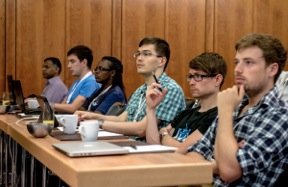
“Students hear Axel Clauberg explain why Deutsche Telekom supports the work of the IETF.”
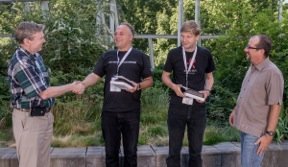
Kevin Craemer and Steve Conte of ISOC thank Professors Thomas Schmidt of Hamburg University of Applied Sciences and Matthias Wählisch of Freie Universität Berlin for their support of the IETF University Outreach pilot programme.”